By David Rupiny
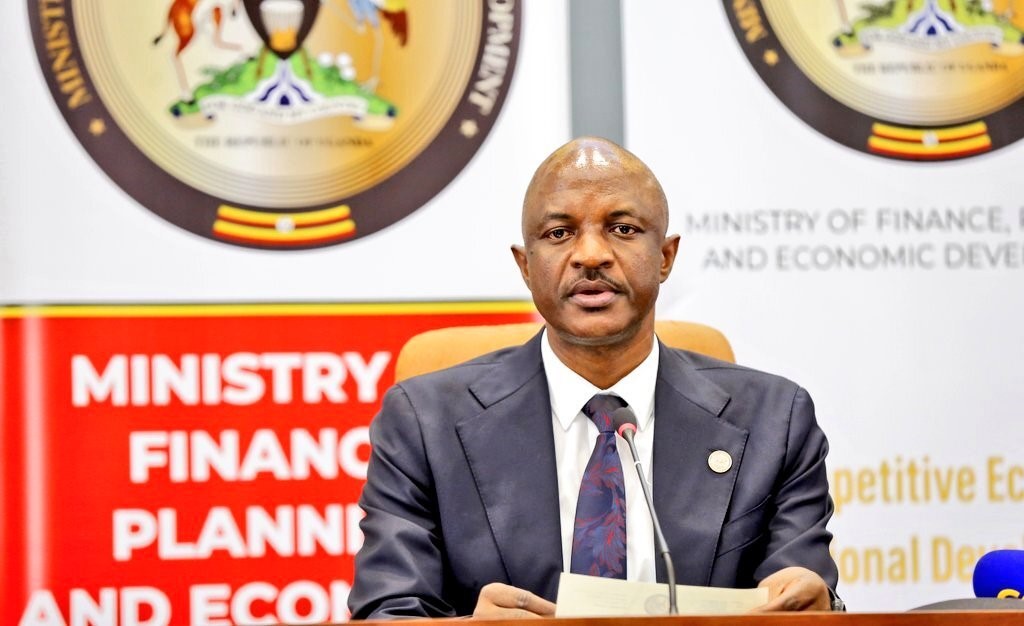
Uganda’s Permanent Secretary for Finance and Secretary to the Treasury, Dr. Ramathan Ggoobi, says that despite global and regional geopolitical tensions, the country’s economic performance is resilient and the outlook is positive.
Speaking at the fourth-quarter expenditure release for the financial year 2025/26, Ggoobi said preliminary estimates show that the economy expanded by 8.5 percent in the second quarter of the financial year 2025/26, from 5.4 percent recorded in the same period during the financial year 2024/25.
“The average economic growth for the first half of FY 2025/26, therefore, increased to 6.7 percent from 5.8 percent during the same period last year,” said Ggoobi.
He said this strong performance was primarily driven by robust aggregate demand, investment and exports, reflected by increased production in the industrial, services, agriculture, forestry and fishing sectors of the economy.
Other economic drivers included increased FDI, especially in oil and gas, agriculture and agro-industrialisation, tourism, mineral development, and science, technology, and innovation, commencement of oil production, political stability, peace, and security, and a stable macroeconomic environment.
“By the end of June 2026, GDP is projected at 68.4 billion dollars (UGX251.4 trillion), equivalent to 194.2 billion dollars in Purchasing Power Parity (PPP) terms, while GDP per capita is projected at 1,399 dollars (UGX5.o3 million) in June this year,” said Ggoobi.
Ggoobi said that with the commencement of oil production later this year, double-digit growth is projected in the financial year 2026/27.
On the monetary front, Ggoobi said the Ugandan Shilling has performed strongly due to prudent economic management that includes an open capital account, diversified exports, a liberalized foreign exchange market, and an active FDI policy.
He said the recent government decision to import refined petroleum products directly from producers contributed to the strengthening of the shilling, which is projected to remain strong and stable, despite recent mild depreciation pressures driven by speculation around the conflict in the Middle East.
***