
By David Rupiny
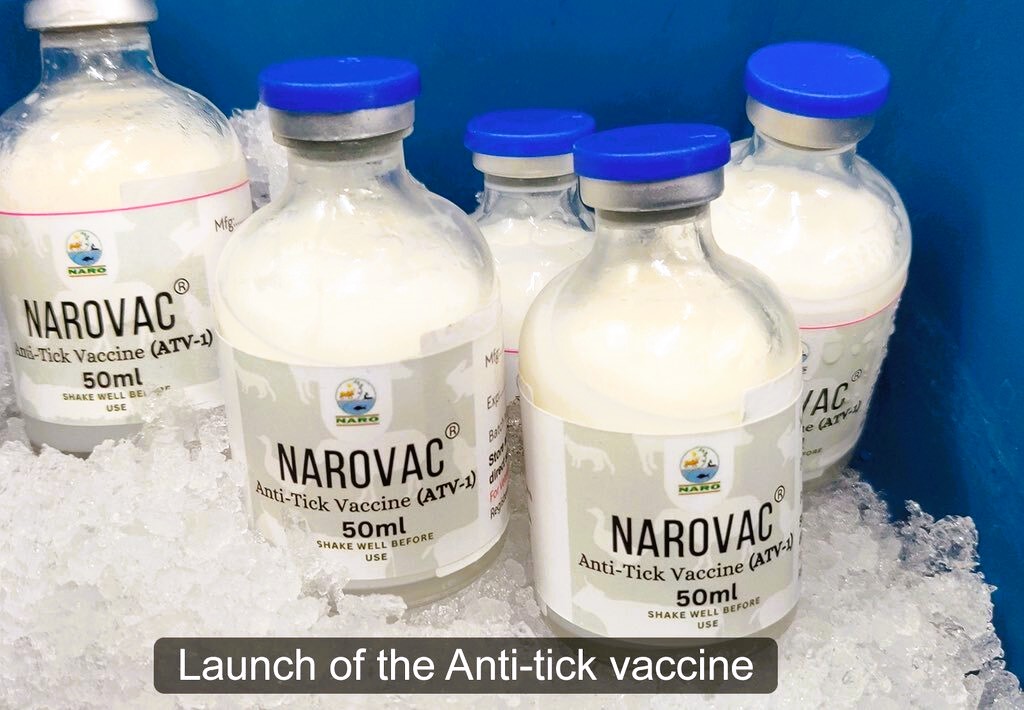
On April 30, 2026, President Yoweri Museveni launched Uganda’s first locally developed anti-tick vaccine, branded as NAROVAC-ATV1.
Developed by the National Agricultural Research Organisation (NARO) scientists at the National Livestock Resources Research Institute (NaLIRRI), the vaccine aims to combat the high costs and environmental hazards of chemical acaricides while addressing tick-borne diseases that cause massive losses for farmers.
For years, tick and tick-borne diseases have undermined livestock production and productivity in Uganda and across Africa, costing farmers billions in losses through reduced milk yields, poor weight gain, and high mortality rates.
The technology was built by local science and backed by strategic investment. The development process was supported by a Government of Uganda investment of approximately UGX170 billion, which funded research, trials, infrastructure development, and the recruitment of skilled personnel.
The newly commissioned facility is located in about 20 kilometres to the north of the capital, Kampala, and has the capacity to produce up to 36 million doses annually, equivalent to about three million dozes a month, serving 16 million head of cattle. One and a half million doses have already been produced.
According to Dr. Swidiq Mugerwa, the Deputy Director General of the National Agricultural Research Organisation (NARO) and one of the scientists behind the vaccine, it was developed using recombinant technology which utilizes antigens derived from local tick species, specifically the Subolesin protein. It induces antibodies in the cow’s blood that kills ticks when they feed.
“When this protein is formulated into a vaccine and injected into the cow, the animal’s immune system recognizes it as foreign and produces antibodies against it. When a tick feeds on the cow’s blood, it ingests these antibodies, which then act to kill it”, explained Dr Mugerwa.
The vaccine is designed for cattle from one month old, administered in three initial doses (day 0, day 30, and day 180), providing protection for up to one year, followed by annual boosters every six months to ensure continued immunity.
Trials showed the vaccine is effective with no detectable residues in milk or beef.
The vaccine is expected to retail at approximately 10,000 shillings (2 dollars, 50 cents), significantly lower than the estimated 60,000 shillings (15 dollars) per cow per year that farmers currently spend on chemical treatments.
With the NAROVAC-ATV1, Uganda is positioning itself as a leader in investments in science-led agricultural revolution. The initiative aims to reduce the estimated 1.1 billion dollars in annual livestock losses, including devastation by the East Coast Feve, and position Uganda as a regional hub for veterinary vaccines.
The vaccine represents a shift away from reliance on acaricides, which are chemical tick control substances that have long dominated livestock management but ticks have, over time, developed resistance to the chemicals, while their toxicity has raised concerns about environmental safety and quality of food.
Launching the vaccine, President Yoweri Museveni situated the vaccine within Uganda’s broader economic transformation, describing it as part of Uganda’s transition into a science-led economy and what he termed as “phase five of development”.
President Museveni said Uganda’s economic journey has evolved from post-conflict recovery, through expansion and diversification, to value addition, and now to a stage driven by science, technology, and innovation.
“This is why Uganda is unstoppable”, said the President, adding that the Government is committed to investing in science, technology, and innovation.
President Museveni proposed enhanced incentives for scientists, including tax waivers on salaries, to sustain momentum in research and development.
***