By Shamim Saad
President Yoweri Museveni has called for stronger collaboration between Government and the private sector to accelerate industrialization, deepen regional economic integration and drive sustainable economic transformation.
The President’s message was delivered by the Minister of Finance, Planning and Economic Development, Hon. Henry Musasizi, who represented him at the two-day 3rd Annual Regional Industrialization Conference (RIC) 2026, held at Kampala Serena Hotel on August 18 and 19, 2026.
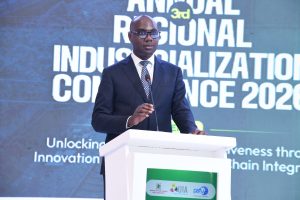
Held under the theme “Unlocking Industrial Competitiveness through Innovation and Regional Value Chain Integration,” the conference brought together policymakers, industrialists, financiers and private-sector leaders to explore practical strategies for advancing industrial development across the region.
Musasizi said industrialization remains central to Uganda’s structural transformation because it creates jobs, adds value to the country’s natural resources, expands intra-regional trade in manufactured goods and reduces vulnerability to external economic shocks.
He noted that Uganda’s industrialization strategy is anchored in the national development framework, with the accelerated development of industrial parks serving as a key pillar.

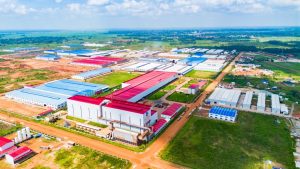
The Minister highlighted the Kampala Industrial and Business Park (KIBP) at Namanve, which covers approximately 1,000 hectares and continues to attract investments in manufacturing, logistics, food processing and agro-processing. The Park is increasingly positioning Uganda as a production hub for both domestic and African markets.
He also cited the Sino-Uganda Bio-Industrial Park, covering approximately 619 acres, which hosts about 75 factories employing more than 12,000 people, as another example of Uganda’s expanding industrial base.
“Government’s industrial parks are being developed as strategic production hubs to serve both Uganda and the wider East African and African markets. Key investment opportunities include agro-processing, leather, textiles, pharmaceuticals, petrochemicals, steel, construction materials and logistics,” Musasizi said.
He urged stakeholders to view East Africa as a shared regional market rather than a collection of separate national economies, noting that the region has a consumer market of more than 400 million people, while the African Continental Free Trade Area (AfCFTA) provides access to a market of approximately 1.4 billion people.

Musasizi reaffirmed Uganda’s commitment to deepening East African Community economic integration through removing non-tariff barriers, operationalizing one-stop border posts and expanding access to regional markets.
He said achieving Uganda’s long-term ambition of growing the economy tenfold to $500 billion will require a genuine and sustained partnership between Government and the private sector.
The Minister of State for Trade, Industry and Cooperatives Industry, Hon. David Bahati, urged East African countries to prioritize increased production, value addition and exports to enhance the region’s industrial competitiveness and unlock greater economic opportunities.
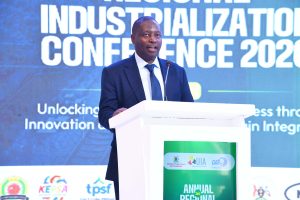
Bahati identified access to reliable power, infrastructure, irrigation, regional connectivity and non-tariff barriers among the key challenges that need to be addressed to accelerate industrialization and expand regional trade.
Meanwhile, Private Sector Foundation Uganda (PSFU) Board Chairman Humphrey Nzeyi noted that manufacturing contributes between 9.7% and 11.8% of regional GDP, which remains below the East African Community industrialization policy target of 25% by 2032.
He said manufacturing contributes more than 16.5% of Uganda’s GDP and supports about two million direct jobs, underscoring its importance to employment, exports, tax revenues and structural transformation.
Nzeyi called for practical interventions to address access to long-term industrial finance, non-tariff barriers, infrastructure constraints, energy costs, standards, illicit trade and cross-border value-chain linkages.
The Deputy Director at the Uganda Investment Authority (UIA), Martin Muhangi, highlighted Uganda’s strong economic performance and the growing investment opportunities across key sectors.
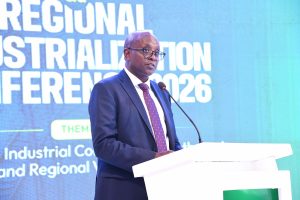
He noted that Uganda’s economy has expanded to $61.9 billion, registering growth of 6.3% in FY2024/25, while Foreign Direct Investment (FDI) inflows increased to $3.5 billion in 2025. The economy is projected to grow by 10.2% in FY2026/27, further strengthening Uganda’s investment proposition.
Our ambition is clear: to grow Uganda’s economy tenfold by 2040, anchored on agro-industrialization, tourism, mineral value addition, and science, technology and innovation. As Uganda strengthens its position as a competitive production hub serving domestic, regional and international markets, we invite investors to partner with us to harness the opportunities ahead,” Muhangi said.
He emphasized that while Uganda has immense natural resource potential, the country’s greatest opportunity lies in transforming these resources into higher-value products, jobs and exports.
Muhangi highlighted investment opportunities across agro-processing, mineral beneficiation, manufacturing, technology and tourism, ranging from coffee, cocoa, dairy and fish processing to gold refining, iron ore beneficiation and rare-earth processing.
He also pointed to Uganda’s Science, Technology and Innovation agenda as a growing area of investment, with opportunities in electric mobility, battery manufacturing, digital technology, software, business process outsourcing (BPO), artificial intelligence and food-processing technologies.
“Our message to investors is simple: Uganda is open for partnerships that create value locally and compete regionally and globally. Let us move beyond exporting raw materials and build industries that capture more value, create quality jobs and accelerate economic transformation,” Muhangi emphasized.
The conference concluded with a renewed call for stronger collaboration between Government and the private sector to translate regional industrialization commitments into increased production, investment, employment and trade.

The 3rd Annual Regional Industrialization Conference therefore provided a platform for stakeholders to strengthen partnerships, identify investment opportunities and advance practical solutions for building competitive industries and integrated regional value chains.
ENDS