By David Rupiny
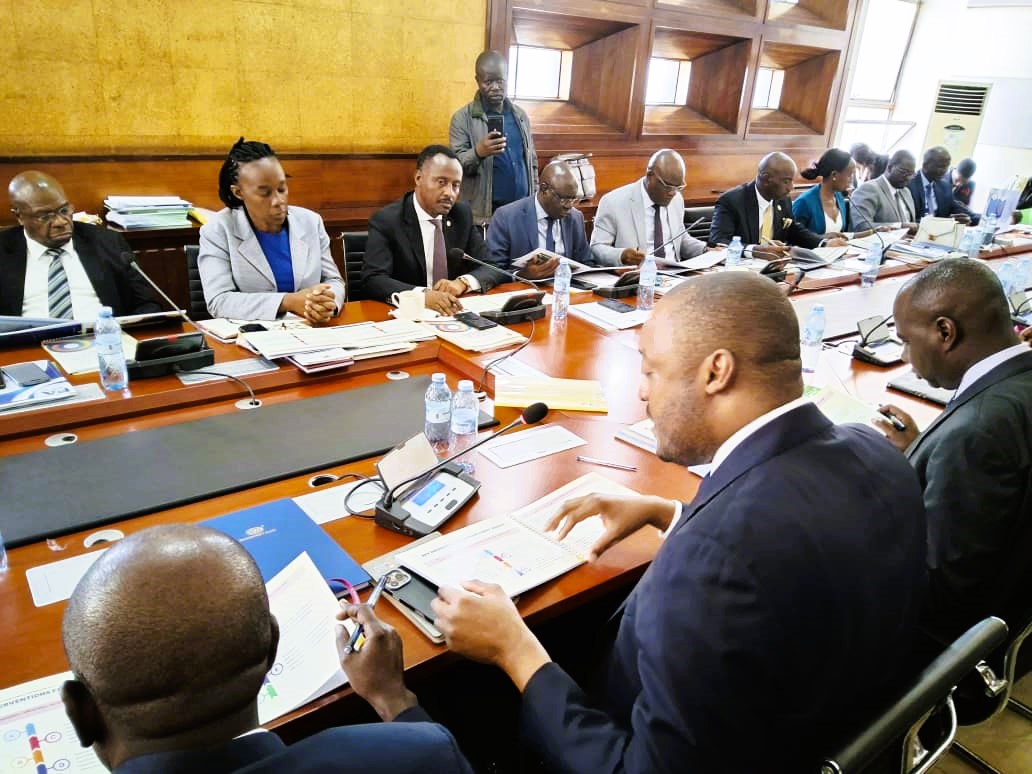
Members of Uganda’s parliamentary committee on finance, planning, and economic development have urged the government to prioritise industrial park development as a strategic intervention in boosting value addition, import substitution, exports, job creation, and sustainable socioeconomic transformation.
The MPs made the call while receiving Uganda Investment Authority’s Ministerial Policy Statement for the financial year 2026/27, presented by the Director General, Robert Mukiza.
The committee, chaired by Rwampara MP, Amos Kankunda, noted that UIA is progressively chalking key achievements in its industrialization agenda, including increasing foreign direct investment to the current 3.5 billion dollars, up from 2.99 billion dollars, as well as facilitating the 4.5-billion-dollar oil refinery investment.
Kankunda said: “We thank the Uganda Investment Authority’s efforts in driving Uganda’s industrialisation as envisioned by President Yoweri Museveni. We are seeing real outcomes, value addition, products, job creation, and increasing market access for Ugandan products”.
“Thanks to UIA, a lot of progress is being made in import substitution. For example, Uganda used to be a net importer of ceramic tiles; now, most tiles are locally made”, observed Kankunda. He urged the government to provide more resources to UIA to expand and scale industrial park development across the country.
Dr. Agnes Atim Apea (Amolatar Woman MP) said: “Reading UIA’s Ministerial Policy Statement, we see you are on the right trajectory. I implore UIA to ramp up its efforts to industrialise all parts of Uganda, and, as Parliament, we shall support you”.
The MP for Buyanja East, Emely Kugonza, said the government and Parliament need to strategically provide resources to UIA to build critical infrastructure in planned industrial parks because investors need serviced parks.
“In our supermarkets, you find 80 percent of products are ‘Made-in-Uganda’ with most of them coming from UIA-operated industrial parks, and we are exporting more”, said Kugonza, emphasizing that the authority needs more resources.
The MP for Sheema Municipality, Dickson Kateshumbwa, said: “When you go to Namanve, Mbale, Kapeeka, MMP Buikwe, Mbalala and other industrial parks that is when you begin to appreciate UIA’s work in industrialising Uganda. Let’s invest in industrial parks for value addition, job creation, and import substitution”.
In his response, the State Minister of Finance (General Duties), Henry Musasizi, said in Uganda’s Tenfold Economic Growth Strategy that aims to grow the economy to 500 billion dollars by 2040, industrial park development (roads-water-electricity) is a key enabler, adding that in the 2026/27 budget the Government will deliberately and intentionally invest in industrial park development.
The minister said priority will be given to infrastructure development in Namanve, Kapeeka, Mbale, Buikwe, and Kasese industrial parks, and the fast-tracking of new industrial parks.
The Director General of UIA, Robert Mukiza, said that to lower the cost of doing business, the authority implemented significant reforms to streamline investor licensing and registration, reducing the time and cost of doing business.
Mukiza said key reforms in lowering the cost of doing business include: reducing the time for investment licensing from 48 hours to 24 hours; reducing the time for company registration from five working days to four hours; instant tax identification number issuance for investors with national identity cards and four hours for others; and reducing work permit issuance from two weeks to two days.
Digitized and digitalized investment services that UIA offers through its One-Stop Centre https://ebiz.go.ug include: business registration validation https://ursb.go.ug; TIN application and validation https://ura.go.ug; COIN application; immigration and visa validation; and social security registration
Key investment milestones as at 30 June 2025 include:
- Facilitation of a 4.5-billion-dollar oil refinery investment.
- Increase in FDI to 3.5 billion dollars from 2.99 billion dollars.
- Licensing of 191 investment projects with $1.2b actual investment, and 26,782 direct jobs created.
- Piloting of the Trader-to-Manufacturer initiative with traders in the Kikubo business district, with 11 investment projects licensed and two actualized.
- 10 operational industrial parks.
- Unlocking investments through mortgages to improve financial access.
- Allocation of industrial land to 674 investors, 54 percent of which are fully operational, and 26 percent are under construction.
- Creating 1,62,183 direct jobs in industrial parks.
- Inking a cumulative capital investment value of 43 billion dollars.
***