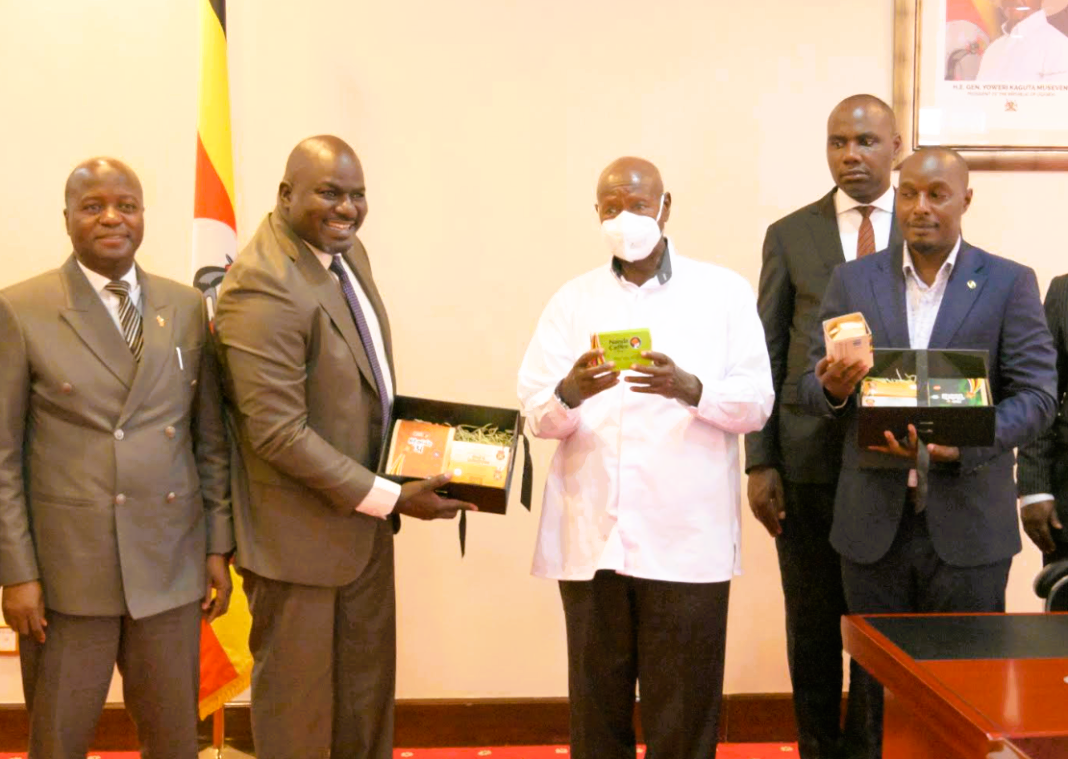

On Friday 31st July 2026, the Uganda Investment Authority One-Stop Centre (OSC) hosted 40 student innovators from the Makerere Innovation and Incubation Centre Startup Hatch 1.0 program to learn about the compliance requirements for innovators.
The young innovators are part of the twenty teams taking part in the Startup Hatch 1.0 program, a fully staged six-month incubation program, focused on transitioning early-stage startups to market ready ventures.
In a bid to mobilize partners to commercialize their projects, the student teams are scheduled to pitch their ideas to panel of investors and judges next month.
The MIIC model, which was inspired by Stanford University and the Silicon Valley, now has a portfolio of over 300 companies, most of which have achieved compliance.
The role of UIA in promoting innovators
The engagement kicked off with a brief tour of the One-Stop Centre led by Josephine Lunkuse, an Administrative Assistant at the One Stop Centre.
“Welcome the One-Stop Centre hosted by the Uganda Investment Authority. The Uganda Investment Authority does not only work with foreign investors but local investors like you”, she said.
The group toured the tills of different Ministries, Departments and Agencies (MDA) that offer investment and business services to investors, both domestic and international, as well as other clients.

Explaining how the Ministry of Lands, Housing and Urban Development supports land acquisition for investors, Josephine said:
“They must make sure that the land is in this person’s name, so they do something called a search report here on land, and also any land related matters, land titles, you can always visit this in case you are purchasing land ‘’
After the tour, Justine Agaba Kasigwa, the Director One-Stop Centre welcomed the innovators to the Auditorium.
“Welcome to Uganda Investment Authority, as you have heard, we have about 15 government agencies that serve at the One-Stop Centre.
“We support businesses from business registration, tax registration, social and environmental impact assessment, and certification of products and standards.
“We have KCCA, we have Power, we have National Water, those of you with international colleagues, we have immigration services, we have everything that you require to start your businesses,” she said.
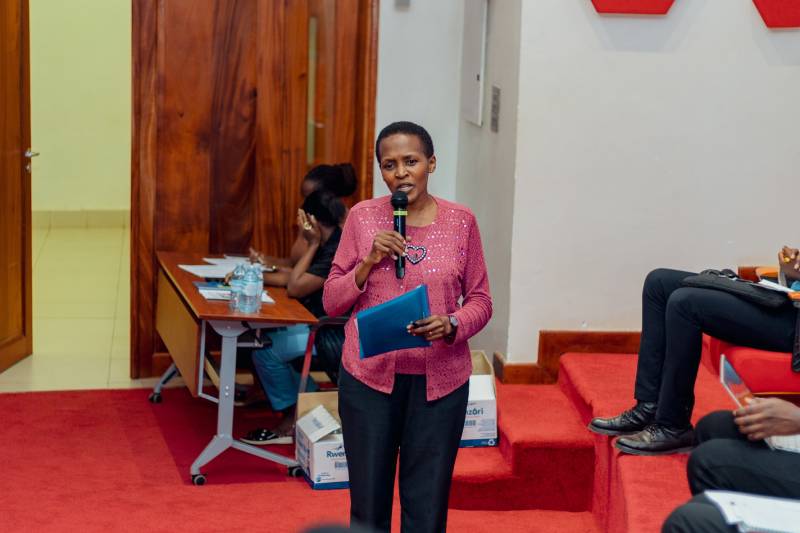
Fred Kakooza, the Deputy Director Operations at the One-Stop Centre highlighted the mandate of Uganda Investment Authority as the marketing arm of the country that promotes and markets investment opportunities, facilitates investments, develops industrial parks and also gave an overview of both the physical and electronic One Stop Centre (www.ebiz.go.ug).
Makerere Innovation and Incubation Centre
In his remarks, Robert Okiror, the Investment and Portfolio Management Officer at the Makerere Innovation and Incubation Centre (MIIC), shared the background and main objective of the Centre.
“MIIC was started in 2017 through a partnership between Makerere University and the Ministry of Finance, Planning and Economic Development. The key objective was to set up a low-cost incubator model that was focused on commercializing university innovations coming from either the faculties or students and ensuring that they can be turned into big companies that are innovating.” said Robert.
The Centre’s low-cost model mainly focuses on innovations that use technology as they are easier to scale.

He explained that the MIIC runs various programs focused on different stages of the investment readiness pipeline. The Startup Hatch 1.0 program for example is primarily for early-stage incubation, bringing together student innovators from multiple sectors such as finance, agriculture, health to refine their concepts. The students who just completed a bootcamp a few back, have also got the opportunity to visit the various incubation hotspots around the city to learn from the industry.
“The program you see here (StartUp Hatch 1.0) is under Venture-Building, which is the middle end of the programming, which is basically incubation but there are companies which fall into Acceleration.
These companies are already in the market, they employ more than two, three, five staff and they fall under Investor Readiness. But there are critical certification standards they have not achieved, for instance, they have innovated a new product but they still do not know how to certify.
So… those are the types of businesses, again we shall be introducing to you and we shall be requesting to you to support us.” Said Robert.
Okiror elaborated that the compliance exploration visit to the OSC was one of the many learning experiences. He further emphasized that they wanted to work closely with Uganda Investment Authority to ensure that all the companies with in their portfolio achieve compliance.
He added that “One of the key components of the program is compliance, meaning that they have to be certified with the different agencies, so we wanted them to come here and ask critical questions that maybe limiting them from achieving their objective because they are currently implementing their workplans”.
Kampala City Council Authority (KCCA)
The Kampala City Council Authority’s (KCCA) Desk Officer at the OSC, Esther Nabbuto, said the authority is the governing body overseeing the capital city on behalf of the central government and works in the five divisions of Kampala (Central Division, Kawempe, Rubaga, Makindye and Nakawa division) while the Ministry of Local Government manages the rest of the country.
Explaining the licensing procedure, Esther mentioned that in Kampala, KCCA works with formalized businesses that are registered with the Uganda Registration Services Bureau (URSB) and also have Tax Identification Numbers (TIN) from the Uganda Revenue Authority (URA).
She said the requirements for the trading license for companies as Certificate of Incorporation, TIN Number and physical location details like Street, Building and Shop Number.
Nabuto also explained that the city has particular zones where one can start a business but not in kiosks by the roadside like in the main boulevard, Kampala Road.

One of the innovators asked about the possibility of getting a trading license without a physical location.
“As you have heard from the investment manager, majority of these are university projects, so as you understand to get q physical address there is a barrier of entry to pay rent and all that. Does the regulation provide an area or gap-hole for businesses that may not be able to afford physical addresses in the meantime but want to begin operations.” he asked.
For the startups concerned about high initial rent costs, Nabuto advised them to consider starting small by sharing spaces with other businesses as the physical location is a mandatory requirement for licensing.
Besides trade licensing, she mentioned other taxes applicable to the business community such as the Local Service Tax for employees remitted to in July to October, after which a penalty of 15% applies. Property rates tax for commercial buildings which is 4% to 6% of the ratable value of the property paid annually and Local Hotel Tax paid by guests and submitted monthly for hotel businesses.
Uganda Registration Services Bureau (URSB)
Clare Ayebare, a Registration Officer with URSB explained the different types of registrations, namely Business Names, Single Member Companies, Companies limited by Shares, and Companies Limited by Guarantee.
Ayebare listed the requirements for formalization:
- Reservation of a business name – 35,000/= (Thirty-five thousand shillings).
- Registration for companies with nominal shares that doesn’t exceed five million shillings (5,000,000/=) – 105,000/= plus stamp duty and 35,000 per form.
- National ID for Ugandans, Passport for Foreigners
- Valid Telephone Number.
She said, “Basically, if your company has a share capital of 1,000,000 shillings, you pay 35,000 shillings for reservation, then around 215,000 shillings for final registration. So if you have interfaced with lawyers who are charging you 1,000,000/= or 2,000,000 shillings to register your company, now you have the right information”.
To register a company, Ayebare said one needs to have a National ID for Ugandans, Passports for Non-Ugandans and a valid telephone number and register online at https://eregistry.ursb.go.ug
Uganda National Bureau of Standards (UNBS)
Peter Mayanja, a standards officer with UNBS, cautioned the innovators to be mindful of standards before production such that the product can trade in Uganda, East Africa and Internationally.
Mayanja said once UNBS has developed the standards, their implementation is often the mandate of another regulatory authority, for instance health devices would be regulated by the National Drug Authority (NDA).
“We work to promote businesses… we come to you, we certify the product because we want your product to be safe and trade in the country, to trade in the region and to trade internationally”, he said
National Environment Management Agency (NEMA)
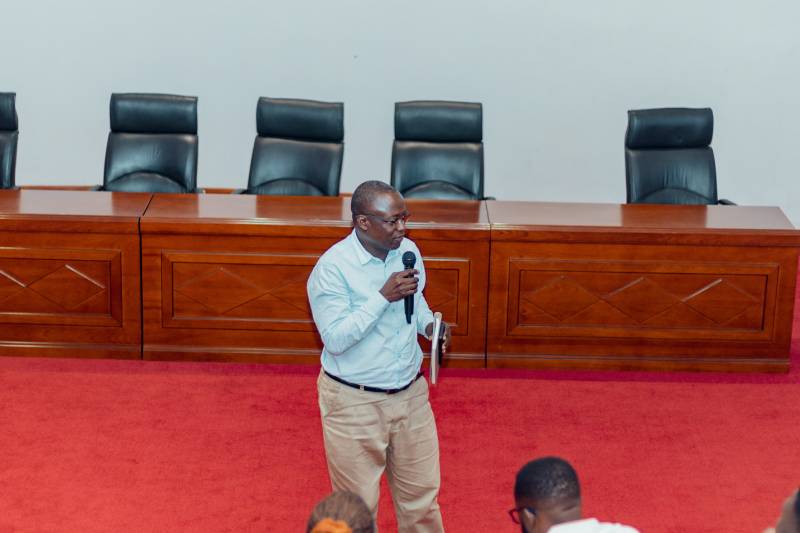
Peter Sekajja, a Senior Environment Officer (Cleaner Production) with NEMA, spoke about the benefits of the Environmental Impact Assessment (EIA). He cautioned the innovators that businesses are now required to show compliance with environmental sustainability to access to financing in banks and also sell to some international markets such as the European Union which has introduced, for example, the EU Deforestation Regulation (EUDR) to curb deforestation, and other regulations.

Uganda Revenue Authority (URA)
Alice Molly Dusabe, working with URA, stressed the importance of paying taxes and filing returns after attaining a company Tax Identification Number (TIN).
Dusabe also highlighted some of the tax incentives extended to approved investors such as duty-free imports of raw materials and machinery.
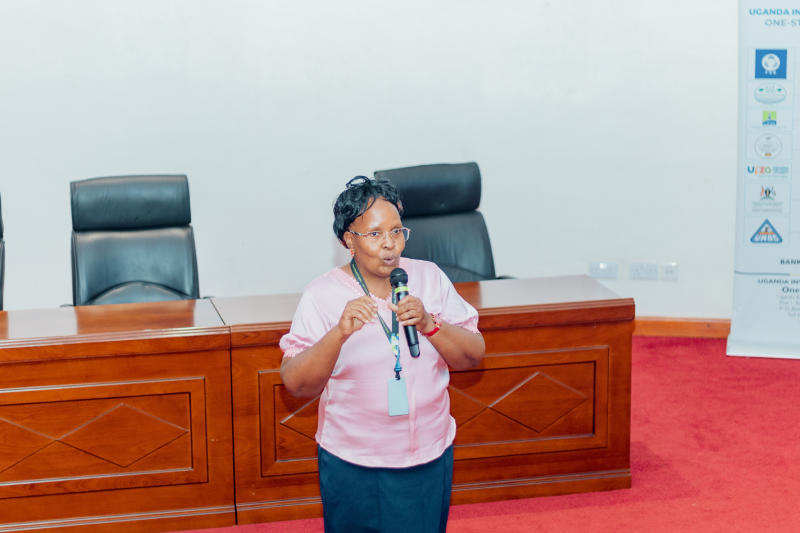
One of the students asked about tax incentives for small businesses
“We are just starting our businesses, do you have some exemptions for some taxes because we have small capital and then we have to pay environmental compliances, local service tax, etc? Do you have some exemptions even when registering a business, for small startups?” she deliberated
Dusabe responded
“The small taxpayer has what we call the presumptive return, that a small tax payer fills, the threshold for that is 10,000,000/=. The least if you are in Kampala, you will pay 80,000/=”.

Reflecting on the visit, one of the innovators, Jemimah Iradikunda said:
“What I have learnt majorly was the standards from UNBS, I did not know that we had standards in Uganda, I didn’t know that we had something to follow before we produce a product.
“I have also liked the presentation from the URA because we have a lot of misinformation in the county”.
Iradikunda is the founder of We Care 256, an innovation venture creating a patient bed with a caretaker’s seat.
In his closing remarks, Fred Kakooza (OSC Deputy Director for Operations) reassured the innovators that the UIA One-Stop Centre is here to support them in their formalization journey as domestic Investors.
***